 CEO Advisory Group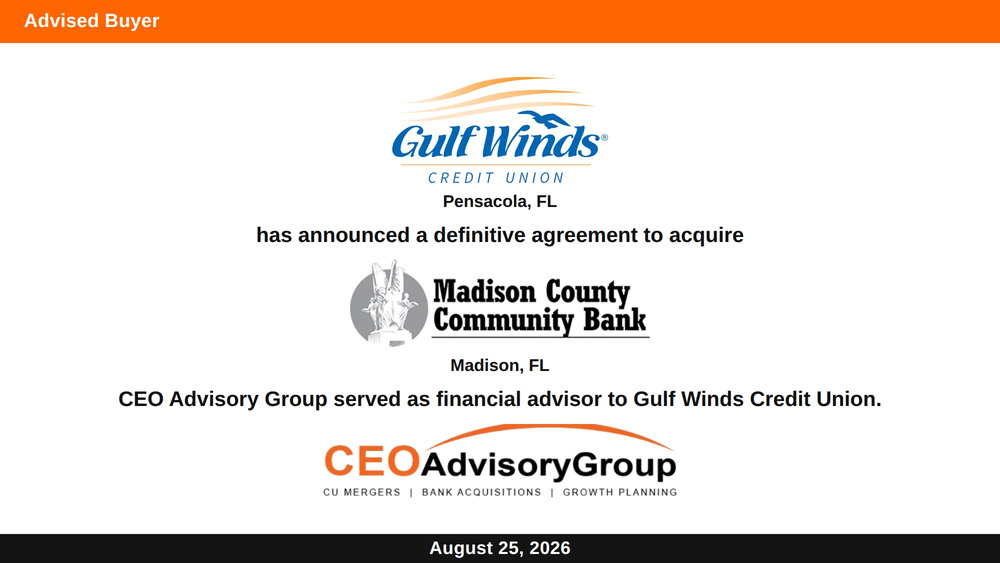
Keeping Rural Florida Banked: Gulf Winds Credit Union to Acquire Madison County Community Bank
On August 25, 2026, Gulf Winds Credit Union of Pensacola, Florida — with more than $1.3 billion in assets and over 74,000 members — announced a definitive agreement to acquire Madison County Community Bank (MCCB) of Madison, Florida, and its parent holding company, Madison Community Bancshares Corporation. MCCB holds approximately $200 million in assets and serves its communities through two offices, in Madison and Perry.
Upon completion, the combined organization is expected to hold more than $1.7 billion in assets, operate 15 locations across Florida and Alabama, and serve more than 87,000 members. Gulf Winds also announced that it will operate under a new name and identity — TruWorth Credit Union — beginning in the spring of 2027.
CEO Advisory Group served as financial advisor to Gulf Winds Credit Union in this transaction. We were privileged to work alongside Daniel Souers and the Gulf Winds leadership team on a transaction that reflects exactly the kind of strategic clarity and community commitment we look for in our clients. For more than 25 years, CEO Advisory Group has worked exclusively in the credit union industry, and we have advised on credit union acquisitions of banks since the earliest days of this activity — including in Florida, where we served as lead financial advisor to Dort Financial Credit Union on its acquisition of West Palm Beach–based Flagler Bank.
What This Transaction Preserves
Madison and Perry are county seats in rural North Florida. Madison County has about 18,800 residents; Taylor County, about 21,200 (Census Bureau, 2025 estimates). These are exactly the kinds of communities that have been losing banking access across the country.
The Federal Reserve Bank of Philadelphia found that between 2019 and 2023, the number of U.S. bank branches fell 5.6 percent, the number of banking deserts grew by 217, and 760,000 more Americans came to live in a neighborhood without convenient access to a bank branch. Lower-income neighborhoods absorbed a disproportionate share of that loss.
Against that backdrop, what Gulf Winds is doing deserves to be named plainly: two offices in rural county seats will stay open, staffed, and serving their communities — with more products behind the counter than they had the week before.
MCCB customers become member-owners of a $1.7 billion institution. They gain expanded consumer lending, sophisticated digital banking, a nationwide surcharge-free ATM network, certified financial coaching, and the rate and fee structure that a not-for-profit cooperative is built to deliver — because a credit union has no outside shareholders to pay, earnings return to members in the form of better rates and lower fees. At the same time, MCCB’s commercial relationships, local underwriting judgment, and experienced lenders carry forward. Small businesses in Madison and Perry keep the bankers who know them, inside an institution with a materially larger balance sheet to lend from.
That is the whole proposition: local service preserved, capacity expanded, consumer and business needs both met. It is what keeps a rural community economically vibrant rather than merely served.
The Consolidation Context That Often Goes Unmentioned
Credit union acquisitions of banks have drawn concentrated criticism from bank trade associations, which have asked Congress and state legislatures to restrict or prohibit them outright. Several states have acted: Mississippi has barred these transactions, Washington imposed a targeted tax on state-chartered credit unions that acquire banks, and regulators in other states have blocked individual deals.
The full data deserves a place in that debate.
We analyzed S&P Global Market Intelligence records for every bank M&A transaction announced in the United States between January 2015 and July 2026 — 2,249 transactions in total. Credit unions were the buyer in 113 of them, or 5 percent. The other 95 percent — 2,136 transactions — had buyers that were overwhelmingly other banks and bank holding companies. Even in 2024, the record year that generated the most alarm, 105 of the 125 bank acquisitions announced were banks acquiring banks.
Community bank consolidation is real, and it is serious. But it is not principally being driven by credit unions. A policy that restricted credit union acquirers would leave 95 percent of the consolidation untouched — while removing one of the few buyers with a demonstrated interest in keeping small rural branches open.
It would also narrow the options available to community bank shareholders. These are voluntary transactions, negotiated between willing parties and approved by the selling institution’s board and shareholders. The board of Madison Community Bancshares Corporation chose this partner. Restricting the field of eligible buyers does not protect community bank owners; it reduces the value and the choices available to them.
One further point is worth making directly. Bank trade groups frequently cite credit unions’ modest share of SBA lending as evidence that credit unions do not serve small business. What that argument omits is that Congress itself capped credit union business lending at 12.25 percent of assets in the Credit Union Membership Access Act of 1998 — and that the same organizations making the argument have lobbied consistently to keep that cap in place. Credit unions are not declining to lend to small business. They are lending up against a statutory ceiling that their critics fought to impose and continue to defend.
Transactions like this one are precisely how credit unions expand real business-lending capacity in markets that need it.
Florida: The Most Active State in the Country
Florida has led the nation in this activity. Of the 113 credit union acquisitions of banks announced since 2015, 18 involved a Florida bank — more than any other state, ahead of Illinois at 17 and Georgia at 10. Gulf Winds joins institutions including MIDFLORIDA, VyStar, FAIRWINDS, Achieva, and Addition Financial, and Madison County Community Bank becomes the nineteenth Florida bank acquired by a credit union in that period.
There are good reasons Florida leads: a deep bench of well-run community banks, sustained population and small-business growth, and a credit union sector with the capital and sophistication to act.
Why This Transaction Works
A disciplined strategic fit. Gulf Winds’ branch franchise has been anchored in the western Panhandle around Pensacola, with a field of membership reaching into South Alabama and South Georgia. MCCB’s offices sit well to the east, across North Florida toward the Big Bend. Rather than buying overlapping branches, Gulf Winds extended into communities it had not previously served.
A textbook acquisition size. At approximately $200 million in assets, MCCB sits almost exactly at the median target size for credit union bank acquisitions since 2015, which is $209 million. Against a $1.3 billion acquirer, it represents roughly 15 percent of the balance sheet — substantial enough to matter strategically and sized to be integrated well.
Commercial capability acquired, not built. For a credit union expanding business services, acquiring established commercial relationships and experienced lenders along with a performing book of business is materially faster and lower-risk than building it hire by hire.
Genuine alignment between the parties. Daniel Souers described the combination as putting a name to what both institutions have always believed — that people come first. Ed Meggs, president and CEO of Madison County Community Bank, described the decision as honoring the bank’s history by building on it. In our experience, that alignment is the single strongest predictor of a partnership that holds up through integration and beyond.
TruWorth: A Confident Statement of Purpose
Gulf Winds paired the announcement with news that it will operate as TruWorth Credit Union beginning in spring 2027, built around the promise We See Your True Worth.
This is a confident and well-timed move. A new identity introduced alongside an expanded franchise gives legacy Gulf Winds members and incoming Madison County Community Bank customers a single, shared starting point — one organization moving forward together, rather than an acquirer and an acquired. Few institutions have the conviction to make that kind of statement, and fewer still have earned the right to. Gulf Winds has.
Looking Ahead
Community banks under $500 million in assets face rising technology and compliance costs, thin succession benches, and shareholders with limited liquidity alternatives. Those pressures are not going away, and consolidation will continue with or without credit union participation.
The question for policymakers is not whether these institutions will change hands. It is who will be permitted to buy them, and what happens to the communities they serve afterward. When a credit union is the buyer, the branches tend to stay, the deposits stay local, the institution answers to its members rather than to outside shareholders, and the customers gain access to a broader set of consumer and business products than a $200 million bank can offer on its own.
Madison and Perry are about to see that firsthand. We congratulate Daniel Souers, Ed Meggs, and both organizations, and we were proud to serve as financial advisor to Gulf Winds Credit Union.
Learn more about this trend when you download our free white paper, “What Credit Unions Need to Know About Bank Acquisitions.”
For more information about how CEO Advisory Group can assist your credit union with merger and acquisition strategy, please contact us at glennc@ceoadvisory.com or visit ceoadvisory.com.
Glenn Christensen is CEO of CEO Advisory Group, the first M&A advisory firm to exclusively serve the credit union industry. Over the past 25 years, the firm has helped credit unions identify and facilitate merger and acquisition transactions with both credit unions and banks.